
The cost of using a car can vary significantly — and that difference is not always where most people expect it to be. For those considering switching vehicles or simply looking to reduce everyday expenses, this analysis goes beyond the price of fuel or electricity at any given moment, and also takes into account the total cost over time.
In the case of combustion engine cars, costs are more exposed to fluctuations in fuel prices and to how the vehicle is driven in different conditions. With electric cars, the comparison usually involves additional factors, such as the cost of charging at home or on the public network, the vehicle’s efficiency, and maintenance over time.
The International Energy Agency highlights that electric vehicles can offer a lower total cost of ownership, mainly due to reduced energy and maintenance expenses.
Beyond the financial aspect, this comparison also reflects a broader shift in mobility. According to the European Environment Agency, transport remains a significant contributor to greenhouse gas emissions in Europe, which helps explain the growing interest in more efficient and electrified alternatives.
In this article, the comparison is presented in a practical and balanced way: from upfront costs to cost per kilometre, including the factors that influence day-to-day usage, additional expenses, and the situations in which an electric car may — or may not — be more cost-effective than a combustion engine vehicle.
Upfront cost vs cost over time
Electric cars tend to have a higher upfront cost than combustion engine vehicles, but this difference can be offset over time through lower running costs.
The purchase price remains one of the main factors in the decision. In many cases, electric vehicles represent a higher initial investment, largely due to the cost of batteries — one of the most significant components of the vehicle.
However, looking only at the purchase price can give an incomplete picture. As the vehicle is used over time, other factors come into play that influence the total cost of ownership, such as:
- lower cost per kilometre
- reduced maintenance needs
- access to tax incentives or local benefits
For a more complete analysis, it is important to consider the total cost of ownership (TCO). This metric includes not only energy costs, but also maintenance, taxes, insurance and vehicle depreciation.
According to the Ayvens Car Cost Index 2026, this combination of factors has a significant impact on the real cost of using a vehicle, showing that comparisons should not be based solely on purchase price or fuel costs.
The same report highlights an important difference: electric vehicles tend to have significantly lower energy costs, while other factors, such as depreciation, may carry more weight in the total cost.
In practice, this means that the cost of a vehicle is not defined only by what is paid at the time of purchase, but by how that cost evolves over time.
In many cases, this translates into a break-even point — the moment when the total cost of an electric car becomes equal to or lower than that of a combustion engine vehicle. While this point varies depending on usage patterns, several studies on total cost of ownership indicate that this balance is often reached within the first years of use, especially when there is access to home charging and regular vehicle usage.
Simulation tools, such as the Electric Vehicles Total Cost of Ownership Tool from the International Energy Agency (IEA) — shown below — help to visualise this evolution in a practical way.
In a high-usage scenario — for example, 40,000 km per year — it is possible to observe that, despite the higher upfront cost, the cumulative cost of a small electric vehicle tends to grow more slowly than that of a combustion engine car, resulting in a meaningful difference over time.
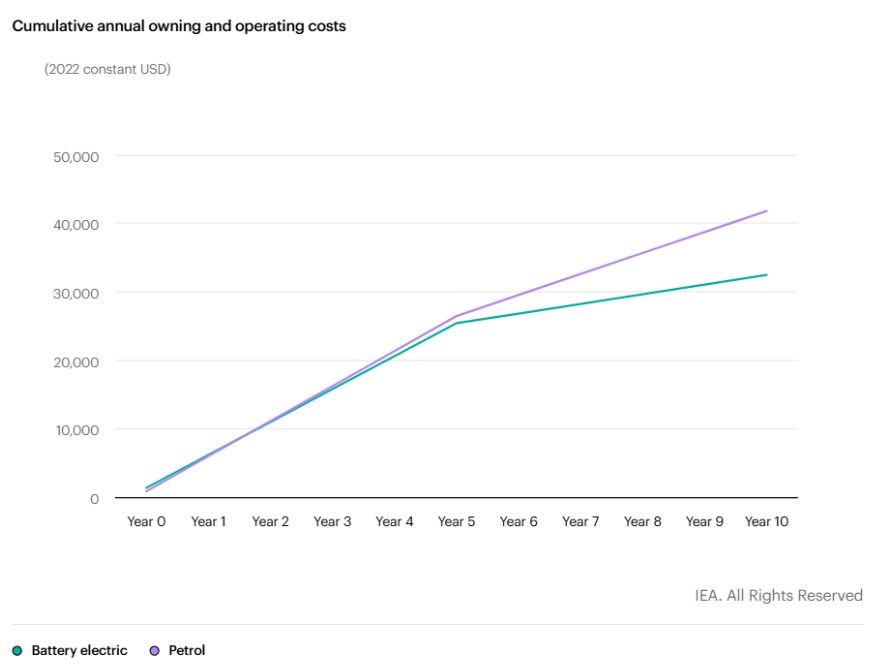 Source: International Energy Agency
To make this difference more tangible, it is useful to look at a simple example.
Consider a driver who travels around 30,000 km per year.
In a typical scenario:
- a combustion engine car may have annual energy costs between €2,400 and €3,600
- an electric car, primarily charged at home, may reduce this to around €1,000 to €1,600 per year
Over several years, this accumulated difference can represent significant savings, helping to offset the initial investment more quickly.
The higher the vehicle usage, the greater the impact of energy costs on the final decision.
This type of analysis shows that the decision should not be based solely on the purchase price, but on a broader view of usage over time.
How much does it cost to use an electric car vs a combustion engine car?
In general, an electric car has a lower cost per kilometre than a combustion engine vehicle, especially when charging is done at home.
This cost can vary depending on several factors, but the difference between electricity and fuel tends to be significant in Portugal and across most European scenarios.
Average cost comparison per 100 km
| Vehicle type | Average cost per 100 km |
|---|---|
| Electric car (home, off-peak tariff) | ~€2.1 |
| Electric car (home, standard tariff) | ~€3.2 |
| Electric car (public network) | ~€7.9 |
| Electric car (average) | ~€3.5 |
| Petrol car | ~€9.8 |
| Diesel car | ~€7.6 |
In practical terms, this means that travelling the same distance tends to cost significantly less with an electric car — especially when charging is done at home.
These values are based on data from the UVE – Electric Vehicle Users Association, which regularly analyses the average cost per 100 km in Portugal. While these figures may change over time, they clearly highlight a consistent trend: the cost per kilometre is generally lower for electric vehicles.
Reports from the International Energy Agency (IEA) point in the same direction, showing that electric vehicles often have lower energy costs per kilometre than combustion engine vehicles across many European markets, particularly when charged at home.
Why does this difference exist?
The cost difference between electric and combustion vehicles is largely linked to how each technology uses energy.
Energy efficiency
Electric motors are significantly more efficient, converting around 85% to 95% of energy into motion.
By contrast, combustion engines use only about 20% to 30% of the fuel’s energy, with the rest lost mainly as heat.
This means that, to travel the same distance, a combustion engine car requires more energy — and therefore incurs higher costs.
Energy prices
Electricity, especially when used at home, tends to be more stable in price than fossil fuels, which are more sensitive to external factors such as international markets and taxation.
An important point to consider
Despite the general advantage of electric vehicles, the cost difference can narrow in certain scenarios:
- when charging is done mostly at fast chargers
- when electricity prices are high
- when the vehicle has higher-than-average consumption
On the other hand, users who charge at home and drive regularly tend to benefit from significantly lower day-to-day costs.

What influences day-to-day costs
Average values help compare electric and combustion engine vehicles, but they rarely reflect the real cost of use for each driver.
In practice, this cost depends mainly on how the vehicle is used and the conditions in which it is driven.
Understanding these factors is essential to get a more realistic — and more useful — view of day-to-day costs.
Type of charging or refuelling
For electric cars, where the vehicle is charged has a direct impact on cost:
- home charging tends to be the most economical option, especially with off-peak tariffs
- public charging networks can be more expensive, depending on the operator and power level
- fast chargers are generally more costly and are mostly used on longer trips
For combustion engine vehicles, although the process is more uniform, fuel prices can vary between stations and regions, influencing the final cost.
Vehicle consumption
Consumption varies depending on the model, but is also influenced by factors such as:
- driving style (acceleration, steady speed, braking)
- vehicle weight and load
- type of journey (urban, mixed, or motorway)
For both electric and combustion vehicles, more efficient driving results in lower costs per kilometre.
Usage patterns
How the vehicle is used over time also affects the overall cost:
- short urban trips can favour electric vehicles, especially due to energy regeneration
- long journeys with frequent use of fast charging can increase costs
- regular and predictable usage tends to maximise the advantages of electric vehicles over time
Energy / fuel prices
The cost of use is directly linked to energy prices, which can vary across countries, regions and over time.
In the case of fossil fuels, prices tend to be more volatile, influenced by factors such as international markets, energy policies and geopolitical contexts. This variability can directly impact the cost per kilometre over time.
Electricity, especially when used in a domestic setting, tends to be more stable, allowing for more predictable running costs.
External conditions
There are also external factors that can influence consumption and, consequently, cost:
- very low temperatures can affect battery efficiency
- heavy traffic increases fuel consumption in combustion vehicles
- use of climate control impacts both types of vehicles
Small differences in usage — such as where the vehicle is charged or how often it is driven — can have a significant impact on the final cost.
More than choosing between electric and combustion, the real difference lies in how each vehicle is used on a daily basis — and that is often where the greatest opportunity for savings can be found.
Additional costs: maintenance, taxes and fees
Beyond energy costs, there are other expenses associated with using a vehicle that have a direct impact on the total cost over time. The most relevant include maintenance, taxes and other charges related to vehicle use.
Maintenance
In general, electric cars tend to have lower maintenance costs than combustion engine vehicles.
This is largely due to their simpler architecture. Unlike combustion engines, electric motors have fewer components subject to wear and do not require regular operations such as oil changes, filter replacements or exhaust system maintenance.
In addition, regenerative braking — present in electric vehicles — reduces brake wear, contributing to less frequent replacements over time.
This combination of factors means that, in everyday use, maintaining an electric vehicle is often simpler and more predictable. In some cases, studies suggest that maintenance savings can reach around 40%.
That said, there are also aspects to consider. The higher weight of electric vehicles and instant torque can lead to increased tyre wear. In the long term, the battery represents the component with the greatest potential cost impact, although it is typically covered by extended manufacturer warranties.
Taxes and incentives
In several European countries, electric vehicles benefit from more favourable tax frameworks, particularly in the context of the energy transition and emissions reduction.
These benefits may include:
- reduced or exempt vehicle registration taxes
- lower annual circulation taxes
- purchase incentives
- tax advantages for businesses and fleets
On the other hand, combustion engine vehicles are often subject to higher taxation, largely linked to their CO₂ emissions.
It is important to note that these incentives vary by country and may change over time, which can influence the overall cost of ownership.
Other fees and associated costs
In addition to maintenance and taxation, there are other costs that may affect day-to-day use:
- parking (in some cities, electric vehicles may benefit from preferential conditions)
- tolls or differentiated urban access
- mandatory periodic inspections
These factors depend on the local context, but can either increase or reduce the total cost of ownership.
When considered together, these additional costs help explain key differences between electric and combustion vehicles.
Although they vary depending on the country and usage profile, the combination of lower maintenance needs and potential tax benefits tends to favour electric vehicles over time.
Additional benefits (non-financial)
Beyond running costs, choosing between an electric car and a combustion engine vehicle also involves other factors that can directly impact the user experience and the context in which the vehicle is used.
Although these aspects are not always reflected in immediate monetary terms, they can influence the decision in the medium and long term.
Environmental impact
Electric vehicles contribute to reducing greenhouse gas emissions and air pollution, particularly in urban environments.
According to Transport & Environment, electric cars produce significantly lower emissions over their lifecycle compared to combustion engine vehicles, even when electricity production is taken into account.
This difference has a direct impact on air quality in cities, helping to reduce pollutants such as nitrogen oxides (NOx) and fine particulate matter.
Access to urban areas and future restrictions
Many European cities are introducing low emission zones and restrictions on more polluting vehicles.
In this context, electric vehicles tend to offer:
- greater freedom of movement in urban areas
- lower risk of future restrictions
- better alignment with sustainable mobility policies
This factor is becoming increasingly relevant, particularly for those who regularly drive in urban environments.
To better understand the applicable rules, it is important to check the low emission zones (LEZ) in the city where the vehicle will be used.
Incentives and non-financial benefits
In addition to tax incentives, there are also practical benefits associated with electric vehicles, which may vary depending on the country or city:
- access to dedicated parking spaces
- preferential conditions in urban areas
- priority access to certain infrastructure or services
These benefits are not universal, but they can contribute to a more convenient overall experience.
Driving comfort and experience
Electric vehicles offer a distinct driving experience, characterised by:
- quiet operation
- smooth and immediate acceleration
- absence of vibrations typical of combustion engines
These factors contribute to greater comfort, especially in urban driving or frequent journeys.
Although these aspects do not directly affect the cost per kilometre, they can significantly influence the perceived value of the vehicle over time.
Taken together, they help explain why choosing an electric car is not only an economic decision, but also one related to usage context, comfort and the evolution of mobility.
When an electric car may not be the best option
An electric car is not always the best choice. In some scenarios, cost, convenience or usage patterns can reduce — or even offset — its advantages.
Identifying these situations helps support a more informed and realistic decision.
Lack of access to home charging
One of the main factors influencing the viability of an electric car is access to home charging.
Without this option:
- the user may rely entirely on public charging networks
- charging costs tend to be higher
- day-to-day convenience may be reduced
In this context, the economic advantage of an electric vehicle may decrease.
Frequent reliance on fast charging
Fast charging is a practical solution, especially for long trips, but it generally comes at a higher cost per kWh.
When used regularly:
- it increases the cost per kilometre
- it reduces the cost gap compared to combustion vehicles
- it can impact long-term running costs
Infrequent usage
For drivers who use their car only occasionally:
- savings on energy and maintenance may be limited
- the initial investment may take longer to offset
In these cases, the economic advantage of an electric vehicle tends to be less evident.
Higher upfront costs
Despite market evolution, electric cars still tend to have a higher purchase price in many cases.
For some users:
- this initial investment may not be justified
- the time needed to offset the difference may be longer
Limited infrastructure in some regions
Although charging networks are expanding, their availability can vary depending on the region.
In areas with lower coverage:
- planning charging may be more demanding
- the overall user experience may be less convenient
Choosing between an electric car and a combustion engine vehicle depends primarily on how the vehicle will be used.
While electric vehicles may be more advantageous in many scenarios, there are situations where this advantage is less clear — particularly when there are limitations in infrastructure, access to charging or specific usage patterns.
More than choosing between two technologies, the decision ultimately comes down to which option best fits each driver’s reality.
Is it worth it in the long run?
In most cases, yes — an electric car tends to be more cost-effective in the long run, especially when there is regular usage and access to home charging.
Throughout this article, it becomes clear that the difference lies not only in the purchase price, but in the overall cost over time.
In general:
- the cost per kilometre tends to be lower
- maintenance is simpler and, in many cases, more affordable
- there may be tax benefits and other advantages
When combined, these factors tend to favour electric vehicles in terms of total cost of ownership, particularly in scenarios with frequent use.
When it tends to be more advantageous
Choosing an electric car tends to be more beneficial when:
- there is access to home charging
- the vehicle is used regularly
- the driver covers a high number of kilometres per year
- public charging is complementary rather than the main option
In these situations, the cost difference becomes more evident over time.
When the difference may be smaller
On the other hand, the advantage may be less significant when:
- there is no access to home charging
- the vehicle is used infrequently
- there is frequent reliance on fast charging
- the upfront cost plays a decisive role in the decision
In these cases, it may take longer for the cost difference to be offset, or it may be less noticeable.
More than a single definitive answer, the choice depends on how the vehicle is used in everyday life.
Electric vehicles tend to be more advantageous over time in many scenarios, but this advantage is not automatic — it depends on usage conditions and each driver’s context.
Conclusion
Choosing between an electric car and a combustion engine vehicle goes beyond the purchase price. When considering the total cost over time, electric vehicles tend to prove more efficient and cost-effective in many scenarios — particularly when there is regular use and access to home charging.
However, this advantage always depends on the usage context. Factors such as access to charging, usage patterns and local energy costs continue to play a decisive role.
Rather than a universal answer, the decision ultimately comes down to understanding which option best fits each user’s reality — and it is this analysis that allows the best outcome from each solution.
Quick summary: Electric vs combustion
- an electric car tends to have a higher upfront cost, but may offset this over time through lower running costs
- the cost per kilometre is, on average, lower for electric vehicles — especially when charging is done at home
- actual costs vary depending on factors such as charging type, driving style, usage and energy prices
- electric vehicles generally require less maintenance due to their simpler mechanical structure
- tax benefits, access to urban areas and improved driving comfort are additional advantages to consider
- the advantage of electric vehicles is more evident in scenarios with frequent use and access to home charging
- in situations such as lack of home charging or infrequent use, the cost difference may be smaller
- the decision should be based on the total cost of ownership and each driver’s usage context